
Ground Tent vs. Rooftop Tent vs. Inflatable Tent: Which Camping Shelter Fits Your Vehicle and Crew?
The fastest way to choose between a ground tent, a rooftop tent and an inflatable tent is to start with the vehicle rather than with the tent. Hard shell rooftop tents are typically pitched in 3–8 minutes, compared with 15–25 minutes for a ground tent, so a crew that moves camp every morning is really choosing between a short routine and a long one. Ground tents remain the only shelter that travels with you once the car stays parked, and inflatable tents replace the pole frame with air beams for crews who want interior volume without a long pitching sequence.
This guide works through the decision the way a buyer actually makes it: crew size first, then mounting and payload, then pitching time, weather exposure, packed weight, and finally the supply questions that matter if you are buying for a rental fleet, a distributor range or a brand programme. It uses the published specifications of the MARVELOUS rooftop models — the MOT-DYG01, MOT-LK901 and MOT-L800 — as concrete reference points, alongside the market and standards data that frames the category.
What “Fits Your Vehicle and Crew” Actually Means
The question “which camping tent is best?” cannot really be answered, because the three families are not competing on the same criteria. A more useful test is to run every candidate shelter against five constraints that do not change between trips.
Constraint 1 — Crew size and sleeping footprint. The number of sleepers decides the shell, not the fabric. MARVELOUS builds rooftop models for 1–2 people (MOT-LK901), 2 people (MOT-DYG01) and 4 people (MOT-L800), and the packed dimensions differ so much between them — 210 × 125 × 20 cm folded for the MOT-DYG01 against 233 × 155 × 32 cm for the MOT-L800 — that the crew decision effectively settles the vehicle decision as well.
Constraint 2 — Mounting and payload. A rooftop tent needs a roof rack, bed rack or equivalent load-bearing structure, and it places its weight high on the vehicle: the MOT-L800 has a net weight of 140 kg, so the roof rating of the specific vehicle has to be checked before the shelter is chosen, not afterwards. Ground and inflatable tents carry inside the vehicle, which keeps the roof free at the cost of cargo space.
Constraint 3 — Trip cadence. How often does camp move? A crew that pitches once per trip can absorb a 15–25 minute setup. A crew that moves daily cannot, because pitching time, not price, is what compounds across a two-week route.
Constraint 4 — Weather window and storage. Rain resistance and flammability are the performance areas that tent standards specifically test for — ISO 5912:2020 covers safety, performance and fitness for use, including flammability and rain resistance — so waterproof ratings belong in the decision rather than in the fine print. Between trips, a hard shell rooftop tent stays folded on the vehicle, while ground and inflatable tents return to a bag and to storage space.
Constraint 5 — Repairability. This one is usually ignored until the first failure. A frame whose pole segments can be separated and replaced individually can be kept in service; a frame that cannot be serviced turns one broken pole into an unusable shelter. For distributors and rental operators that difference is a spare-parts calculation, not a warranty footnote.
Why Shelter Choice Is Changing: What the Market Data Shows
Three market signals explain why this comparison has become harder rather than simpler.
The overall category is growing. The global camping tent market was valued at USD 6.18 billion in 2025 and is projected to reach USD 10.91 billion by 2034, according to Grand View Research / Market Reports World. Inside that category, the rooftop segment is smaller but concentrated in value: the rooftop tent market was valued at approximately USD 215.5 million in 2024, with hard shell models taking more than 53% of revenue share, according to Business Research Insights. Inflatable tents reached USD 1.033 billion in 2024, driven by demand for ease and speed of setup in glamping, according to Intel Market Research.
Demand is also regionally concentrated. North America holds the largest share of the rooftop tent market at 38.6%, followed by Europe at 27.4%, reflecting established overlanding cultures (Dataintelo). That matters for sourcing, because the specification expectations a supplier has to meet in those markets — hard shells, all-season fabrics, documented waterproof ratings — are largely set by the buyers who dominate volume.
At the premium end, the benchmark set is well known. Alu-Cab (South Africa), iKamper (South Korea), Thule (Sweden) and James Baroud (Portugal) are consistently identified as key competitors in the premium rooftop tent segment in a 2026 industry report. Those names define the comparison an end customer will make, and they are a useful reference when judging where any factory’s own models sit.
A caution about market numbers. Camping tent market estimates vary widely by scope. Market Research Future values the category at USD 4.76 billion and Data Bridge Market Research at USD 1.82 billion, against the USD 6.18 billion figure above, because each report defines the category differently (general camping versus glamping and outdoor gear). When building a business case, compare like-for-like definitions rather than the largest number available.
The technical baseline has also shifted. Hard shell rooftop tents typically use aluminum or ABS plastic shells and provide a setup time of 3–8 minutes, compared with 15–25 minutes for ground tents (Rooftop Tent Market Insights). That gap is the reason the “which shelter” question is now, in practice, a vehicle question.
The Three Shelter Families, and How MARVELOUS Builds Each One
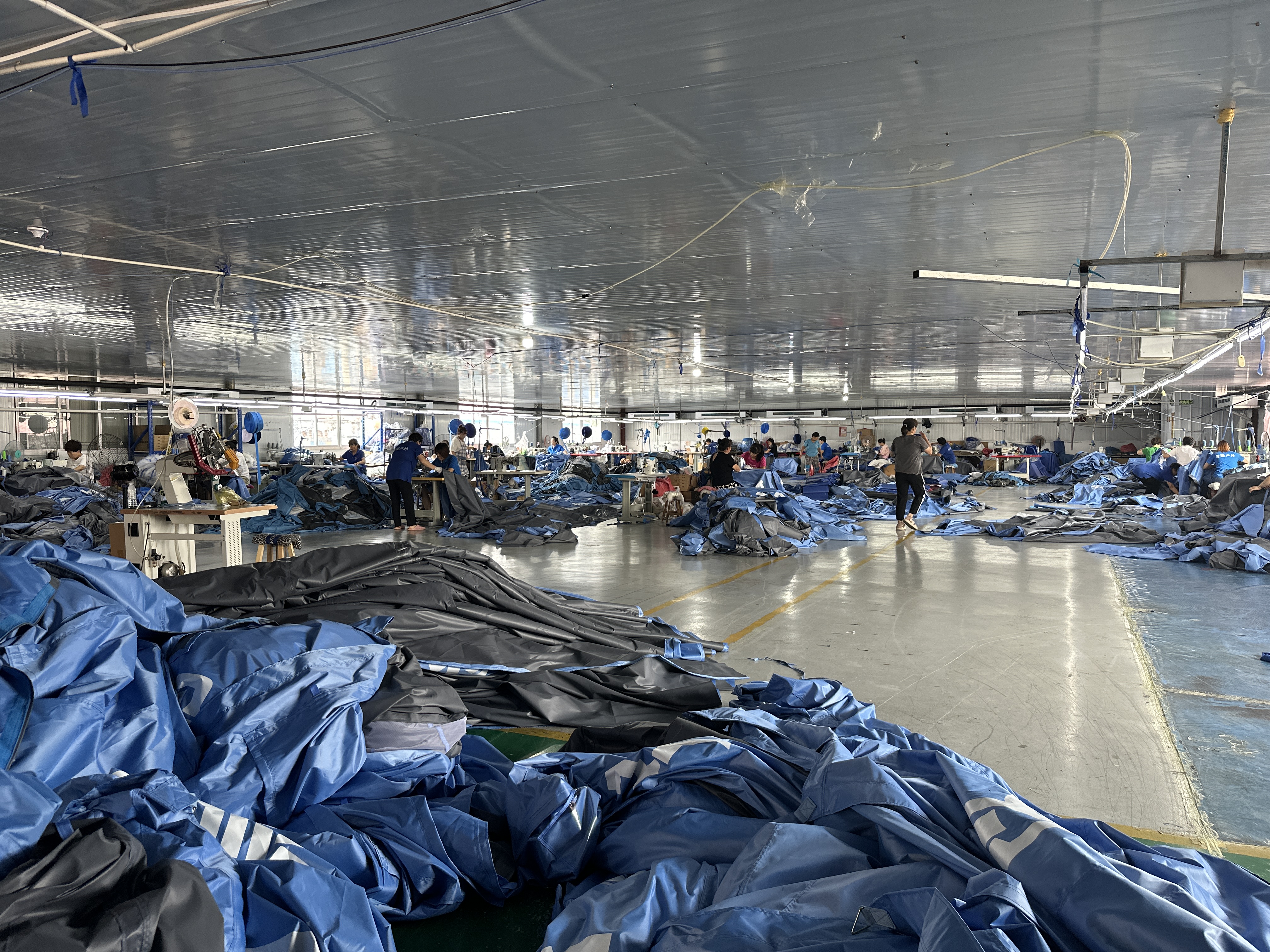
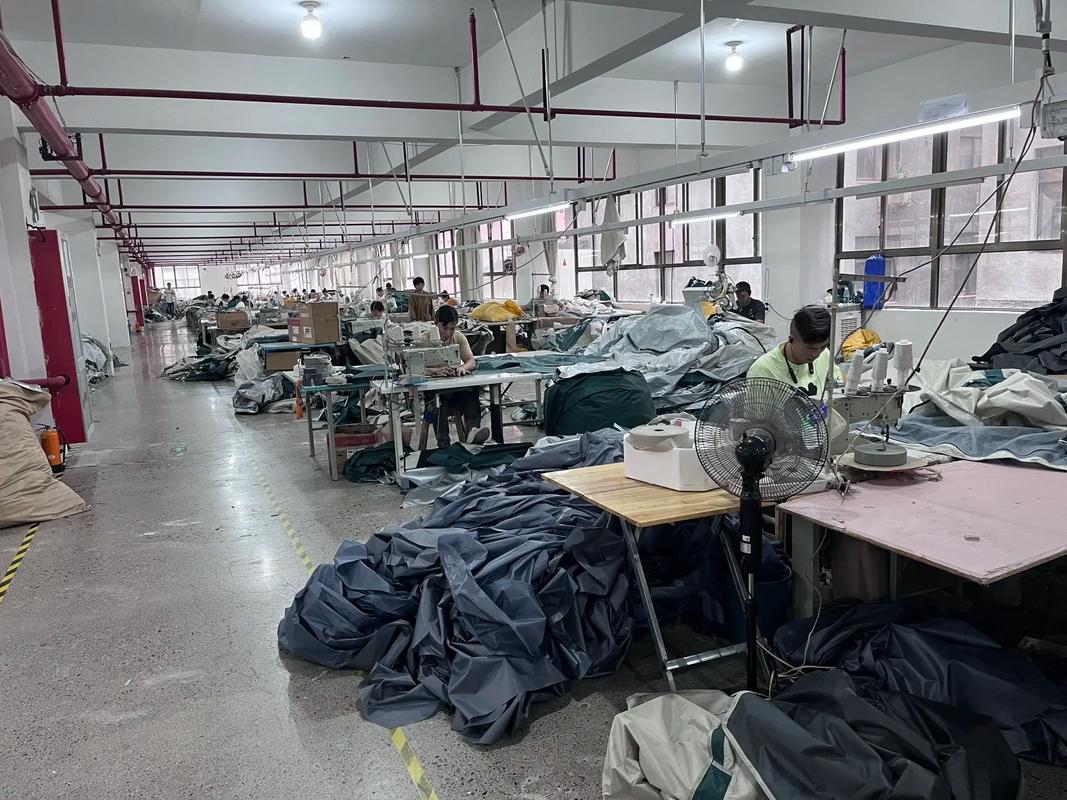
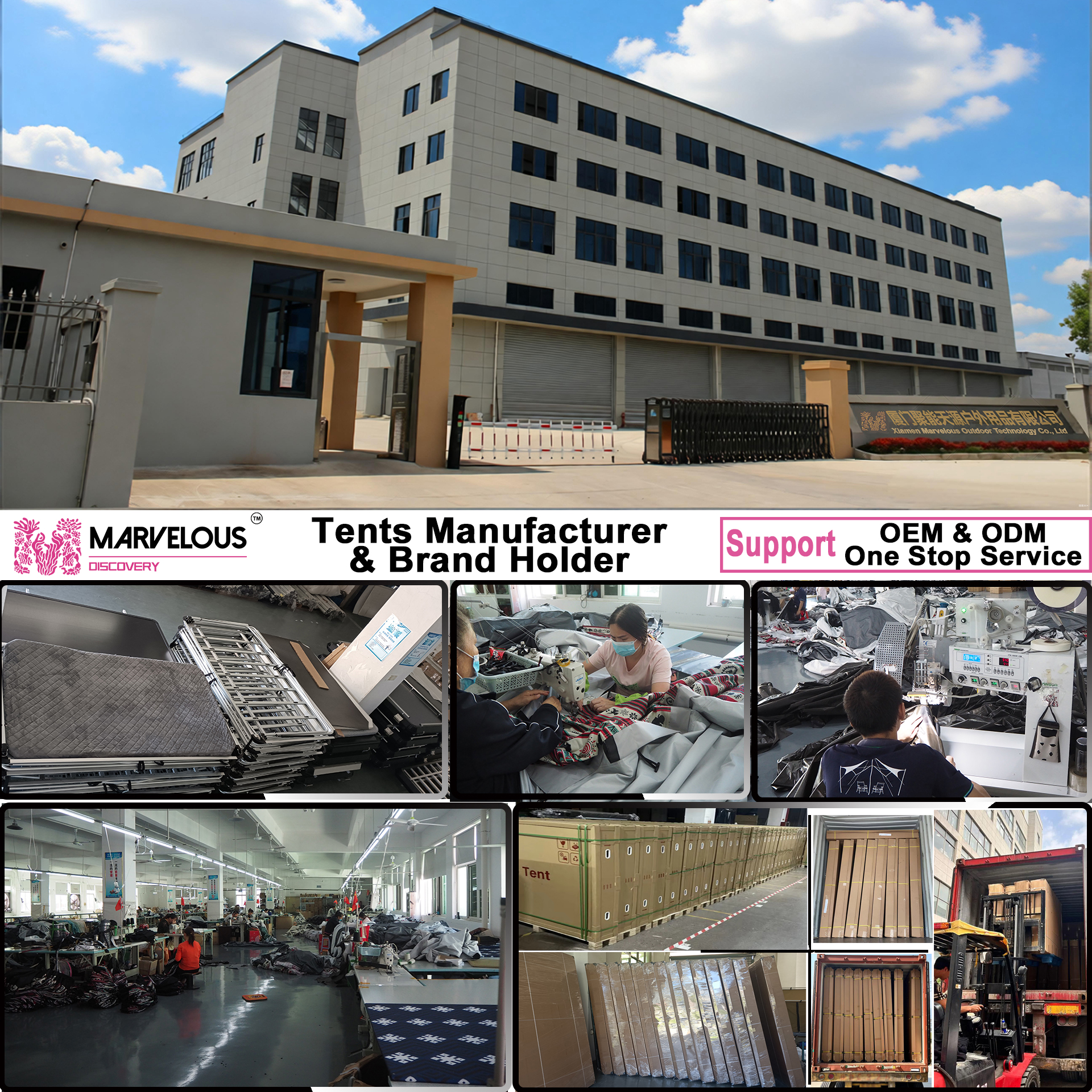
MARVELOUS is the brand of XIAMEN MARVELOUS OUTDOOR TECHNOLOGY Co.,Ltd, an outdoor tent manufacturer founded in 2019 that operates a 4,000 m² factory with 50 employees and a 20-engineer R&D team. Its main products are camping tents, rooftop tents and inflatable tents, and approximately 95% of production is exported, with Russia, the USA, Australia and Canada as the main markets. Because the same factory builds all three families, the trade-offs below are production realities rather than marketing positions.
Ground tents: the default when the car stays parked
Ground tents carry inside the vehicle and pitch on the ground, so they need no rack and no roof rating. The cost is time and effort: 15–25 minutes per pitch according to the source data above, repeated every time camp moves, plus a floor surface that has to be cleared and protected. For hiking and trekking crews, or for touring where the vehicle never moves during the stay, that trade is straightforward. For a crew that relocates every morning, the same 15–25 minutes becomes the largest single time cost of the trip.
Hard shell rooftop tents: fastest deployment, vehicle required
Rooftop tents move the shelter onto the vehicle, which removes ground preparation and shortens pitching to the 3–8 minute range associated with hard shell designs. The current MARVELOUS hard shell range covers three crew sizes with different material specifications:
- MOT-DYG01 — 2-person capacity, aviation aluminium frame, 600D Oxford fabric with a 3500 mm waterproof rating and UV and mould resistance, all-season use, black or customized colour. Folded dimensions 210 × 125 × 20 cm; open size 210 × 125 × 140 cm; N.W./G.W. 32 kg / 45 kg.
- MOT-LK901 — 1–2 person capacity, aluminium shell, outer tent in 420D Oxford cloth with a 280 g polyester-cotton inner tent, PU4000 mm waterproof rating, all-season use. Expanded size 210 × 130 × 140 cm; packing dimensions 223 × 141 × 25 cm; N.W./G.W. 60 kg / 90 kg.
- MOT-L800 — 4-person capacity, aviation aluminium frame, 300D Oxford cloth with a 3000 mm waterproof index, dark gray and orange, all-season use. Expanded size 215 × 251 × 110 cm; packing dimensions 233 × 155 × 32 cm; N.W./G.W. 140 kg / 150 kg.
All three models ship with an aluminium telescopic ladder, an installation bag, a mattress, two shoe bags and two rods, which means each shelter arrives as a complete sleeping system rather than a shell that still needs bedding and a ladder.
The practical reading of the specifications: waterproof ratings run from a 3000 mm index on the MOT-L800 to a PU4000 mm rating on the MOT-LK901, and every model is specified for all-season use. The buyer’s differentiation therefore happens on crew capacity and vehicle payload rather than on weather class — a 4-person shell at 140 kg net weight is a different vehicle conversation from a 32 kg 2-person shell.
Inflatable tents: air beams instead of poles
Inflatable tents replace the pole frame with inflatable air beams. The segment reached USD 1.033 billion in 2024 on the strength of ease and speed of setup in glamping applications (Intel Market Research), and the appeal is easy to state: fewer loose parts, a simpler pitching sequence, and large interior volumes for base-camp use. The trade-offs are equally specific. Inflation depends on a pump or compressor, packed volume is often larger than a comparable pole tent, and field repair of an air beam is a different skill from replacing a pole segment. Buyers should confirm packed volume, pump requirements and spare-beam availability model by model, because these vary by construction rather than by category.
Frames and repairability: what the pole comparison shows
Frame construction is where shelters fail quietly. MARVELOUS documents a comparison between its thicker-diameter aluminium pole and a traditional tent pole: the aluminium option is described as more stable with better pressure-bearing capacity, and it is designed for easy disassembly, with broken pole segments separable for individual replacement. The comparison record alongside it notes a 10% cost difference between the two pole configurations.
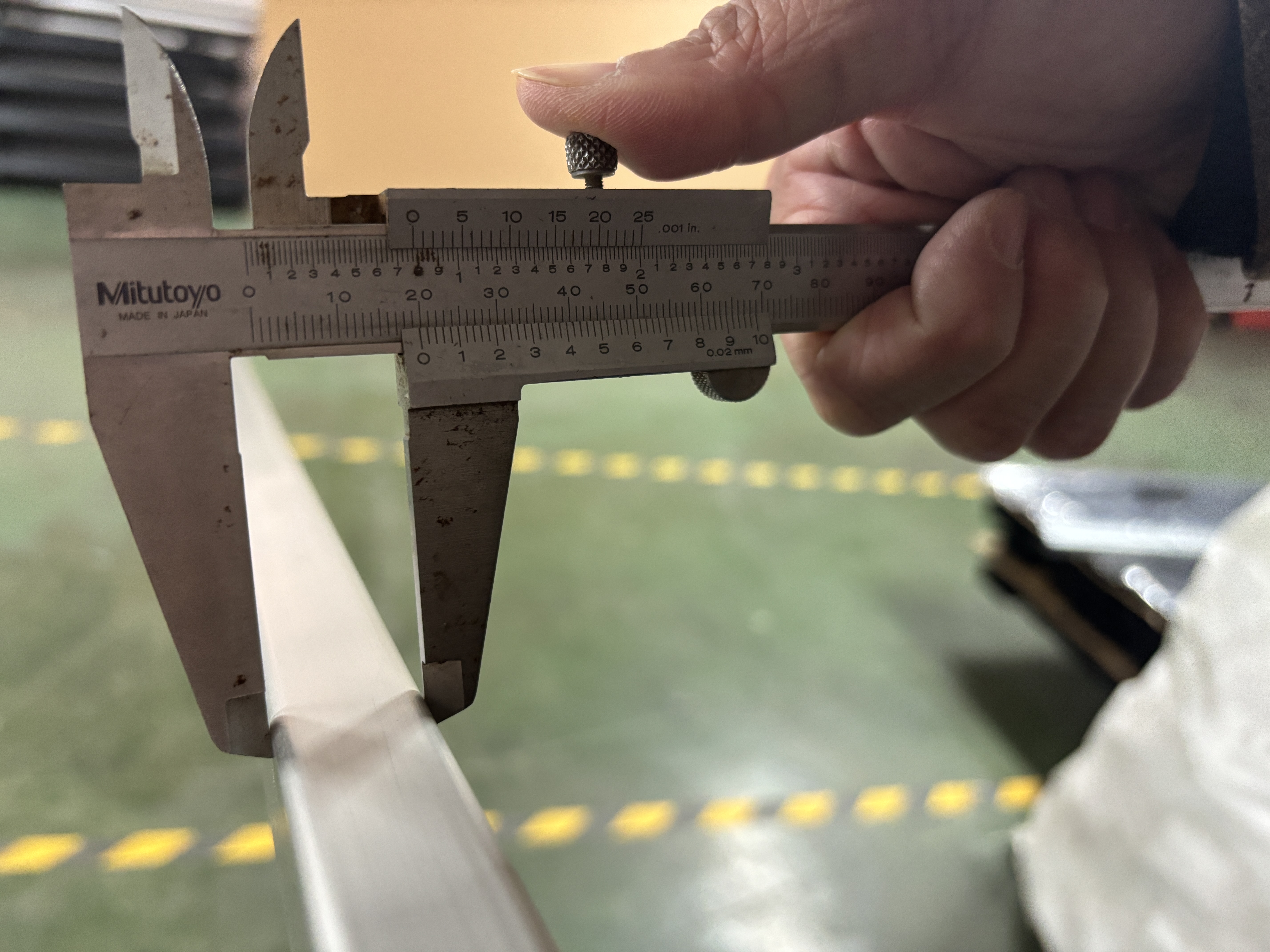
For a distributor, the second half of that statement is the valuable one. Pole segments that separate for replacement mean a damaged tent returns to service instead of retiring, and that is exactly the spare-part design decision which determines whether a rental fleet or a retail range stays profitable in year three.
Fabric, waterproofing and quality control
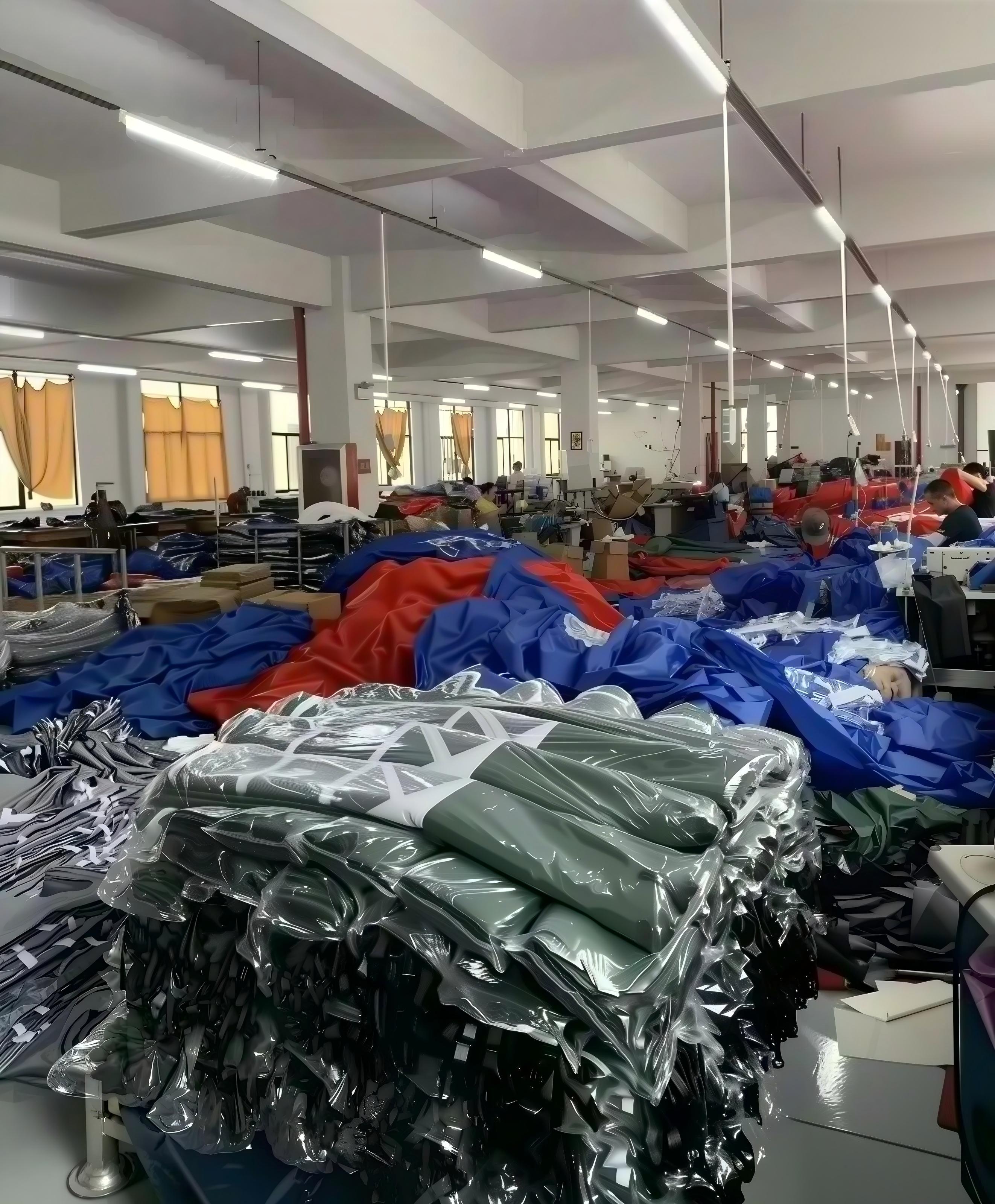
The two failure modes MARVELOUS plans against are fabric cracking and waterproofing that stops working. The control method is to set up the tent and check it piece by piece, and the enterprise measure is that products with defects, or that do not meet the standard during production, are selected out and reprocessed rather than shipped. Both points are worth raising in a supplier audit, because they describe what happens to a non-conforming unit — the part of quality control that is easiest to leave unstated.
Compliance belongs to the same conversation. ISO 5912:2020 specifies safety, performance and fitness-for-use requirements for camping tents, including flammability and rain resistance, and CPAI-84 is a mandatory flammability standard in several US states — California, New York, New Jersey, Massachusetts, Louisiana, Michigan and Minnesota — as well as a federal requirement in Canada. A supplier should be able to show the test evidence behind a specific model rather than a category-level claim.
Step-by-Step: A Seven-Stage Decision Sequence
Working through the following sequence in order prevents the most common purchasing error, which is choosing a shell size before checking whether the vehicle can carry it.
- Count the crew and fix the sleeping footprint. Decide between 1–2, 2 and 4 sleepers. That selects the shell (MOT-LK901, MOT-DYG01 or MOT-L800) and, with it, the packed dimensions you have to accommodate.
- Confirm the mounting platform. For a rooftop tent, verify the rack and the vehicle’s roof load rating against the tent’s net weight — 32 kg for the MOT-DYG01, 60 kg for the MOT-LK901, 140 kg for the MOT-L800. For ground and inflatable tents, confirm cargo volume instead.
- Set a pitching-time budget. Compare the 3–8 minute hard shell range with the 15–25 minute ground tent range and multiply the difference by the number of moves in a typical trip.
- Match the weather window to fabric and waterproofing. Read fabric denier and waterproof rating together: 300D Oxford with a 3000 mm index on the MOT-L800, 600D Oxford at 3500 mm on the MOT-DYG01, and a 420D Oxford outer with PU4000 mm on the MOT-LK901. Confirm UV and mould resistance if the tent will live on the vehicle between trips.
- Audit the included accessory list. All three MARVELOUS models ship with an aluminium telescopic ladder, installation bag, mattress, two shoe bags and two rods. A lower headline price that excludes a mattress and ladder is not a lower total cost.
- Verify compliance and pre-shipment testing before committing volume. Match the destination market to the applicable standards (ISO 5912:2020, CPAI-84) and agree in writing what evidence accompanies each shipment.
- Plan the supply relationship. Confirm MOQ, delivery terms, payment terms and lead time. MARVELOUS works from a 1-unit MOQ with EXW, FOB or CIF delivery and TT or LC payment, accepts pre-shipment testing, and quotes a typical production lead time of 30 days against a monthly production capacity of 5,000–10,000 units.
Use Cases: Matching the Shelter to the Trip
Two people moving every day. The MOT-DYG01 is the smallest hard shell in the range: 2-person capacity, 32 kg net weight, 600D Oxford at 3500 mm, folding to 210 × 125 × 20 cm so the closed profile stays low on the roof. Daily moves are exactly the pattern in which a 3–8 minute hard shell setup pays for itself.
A family of four on a car-camping route. The MOT-L800 is specified for 4 people with a 215 × 251 × 110 cm open footprint and a 3000 mm waterproof index. At 140 kg net weight it demands a serious roof rating, and the packing dimensions of 233 × 155 × 32 cm should be checked against the vehicle before ordering.
A solo traveller or couple touring in variable weather. The MOT-LK901 covers 1–2 people with an aluminium shell and the highest waterproof specification in the range at PU4000 mm, using a 420D Oxford outer tent and a 280 g polyester-cotton inner tent.
A group base camp with vehicle support. Inflatable tents suit a camp that is set up once and occupied for several days, where a simpler pitching sequence and large interior volumes matter more than packed size, and where a pump is available on site.
Hiking and trekking. When the vehicle stays parked and the shelter has to be carried, a ground tent remains the only option of the three, and the 15–25 minute pitching time is simply part of the trip rather than a penalty.
Distributors, rental fleets and retail programmes. For anyone buying in repeat volumes, shelters that can be serviced matter as much as shelters that perform. Separable, individually replaceable pole segments, an accessory set that is complete on arrival, and a supply line with a 30-day typical lead time and 5,000–10,000 units per month of capacity are the operational criteria behind the purchase decision.
Comparison Table: Shelter Family and Model Specification
Two tables answer the two halves of the decision: which family fits the trip, and which model fits the crew and the vehicle.
| Decision factor | Ground tent | Hard shell rooftop tent | Inflatable tent |
|---|---|---|---|
| Typical setup time | 15–25 minutes | 3–8 minutes | Pole assembly is replaced by air-beam inflation; no comparable third-party figure in the source data, confirm model by model |
| Where you sleep | On the ground | On the vehicle roof | On the ground |
| Vehicle requirement | Cargo space; no rack | Roof rack or bed rack; roof load rating checked against tent net weight | Cargo space; no rack |
| Travels with you away from the vehicle | Yes | No — stays on the vehicle | Limited — moves with the vehicle |
| Crew sizes available from MARVELOUS | Confirm per model | 1–2 (MOT-LK901), 2 (MOT-DYG01), 4 (MOT-L800) | Confirm per model |
| Reference net weight | — | 32 kg / 60 kg / 140 kg | — |
| Reference waterproof specification | — | 3000 mm (MOT-L800), 3500 mm (MOT-DYG01), PU4000 mm (MOT-LK901) | — |
| Season specification | — | All seasons (all three models) | — |
| Best-fit trip | Hiking, trekking, budget camping, touring from a fixed base | Overlanding and touring with frequent moves | Base camps and glamping with vehicle support and a pump on site |
| Specification | MOT-DYG01 | MOT-LK901 | MOT-L800 |
|---|---|---|---|
| Capacity | 2 people | 1–2 people | 4 people |
| Frame / shell | Aviation aluminium | Aluminium shell | Aviation aluminium |
| Fabric | 600D Oxford, waterproof 3500 mm, UV and mould resistant | Outer 420D Oxford cloth; inner 280 g polyester-cotton | 300D Oxford cloth, waterproof index 3000 mm |
| Waterproof rating | 3500 mm | PU4000 mm | 3000 mm |
| Season of use | All seasons | All seasons | All seasons |
| Colour | Black / customized | Customized | Dark gray and orange |
| Open / expanded size | 210 × 125 × 140 cm | 210 × 130 × 140 cm | 215 × 251 × 110 cm |
| Folded / packing size | 210 × 125 × 20 cm | 223 × 141 × 25 cm | 233 × 155 × 32 cm |
| N.W. / G.W. | 32 kg / 45 kg | 60 kg / 90 kg | 140 kg / 150 kg |
| Included accessories | Aluminium telescopic ladder, installation bag, mattress, 2 shoe bags, 2 rods | Aluminium telescopic ladder, installation bag, mattress, 2 shoe bags, 2 rods | Aluminium telescopic ladder, installation bag, mattress, 2 shoe bags, 2 rods |
FAQ
What standards should a camping tent comply with in North America and Europe?
ISO 5912:2020 specifies safety, performance and fitness-for-use requirements for camping tents, including flammability and rain resistance, and applies internationally. In North America, CPAI-84 is a mandatory flammability standard for tents in California, New York, New Jersey, Massachusetts, Louisiana, Michigan and Minnesota, and it is a federal requirement in Canada. Because compliance is model-specific, buyers should request the test evidence that corresponds to the exact tent being purchased, not a general statement about the manufacturer.
How much faster is a hard shell rooftop tent to set up than a ground tent?
Hard shell rooftop tents, which typically use aluminum or ABS plastic shells, are pitched in 3–8 minutes, while ground tents take 15–25 minutes (Rooftop Tent Market Insights). Across a trip with daily moves, that gap is the strongest single argument for moving the shelter onto the vehicle.
Which MARVELOUS rooftop tent fits which crew size?
Three sizes cover the range. The MOT-DYG01 sleeps 2 people with a 210 × 125 × 140 cm open size and 32 kg net weight. The MOT-LK901 sleeps 1–2 people, uses an aluminium shell with a PU4000 mm waterproof rating and packs to 223 × 141 × 25 cm at 60 kg net weight. The MOT-L800 sleeps 4 people with a 215 × 251 × 110 cm open size and 140 kg net weight. All three are specified for all-season use and ship with an aluminium telescopic ladder, installation bag, mattress, two shoe bags and two rods.
What waterproof and fabric specifications should be compared?
Compare fabric and waterproof rating as a pair. Within the MARVELOUS hard shell range, the MOT-DYG01 uses 600D Oxford with a 3500 mm rating plus UV and mould resistance, the MOT-L800 uses 300D Oxford with a 3000 mm index, and the MOT-LK901 uses a 420D Oxford outer with a 280 g polyester-cotton inner tent at PU4000 mm. The two failure modes to control are fabric cracking and waterproofing that stops working, which is why piece-by-piece setup checks during production and reprocessing of non-conforming units matter as much as the rating printed on the label.
What makes a camping tent supplier a workable long-term partner in China?
Look for terms you can plan around rather than promises. MARVELOUS works from a 1-unit MOQ with EXW, FOB or CIF delivery and TT or LC payment, accepts pre-shipment testing, and quotes a typical production lead time of 30 days against a monthly production capacity of 5,000–10,000 units — capacity that supports repeat programmes rather than single orders. The business is a family-owned outdoor tent specialist that has designed and produced tents since 1980 and was incorporated as XIAMEN MARVELOUS OUTDOOR TECHNOLOGY Co.,Ltd in 2019; about 95% of production is exported to Russia, the USA, Australia and Canada through distributors as well as direct sales. If you are evaluating a first order or a multi-season programme, send your crew size, vehicle type and target market to jason@marvelous-outdoor.com for a model recommendation, a specification sheet and a quotation — the fastest way to start is to review the full range first.
Conclusion
The three shelter families are not ranked alternatives; they are three answers to different logistics problems. A hard shell rooftop tent buys time at the cost of a mounting platform and roof load — 3–8 minutes per pitch against 15–25 minutes for a ground tent — with an all-season specification across the MARVELOUS range from the 2-person MOT-DYG01 to the 4-person MOT-L800. A ground tent remains the only shelter that goes where the vehicle cannot. An inflatable tent optimises a base camp that is pitched once and occupied for days.
The decision sequence, in one line: crew size first, then mounting and payload, then pitching time, then weather specification, then the supply terms that keep the shelter serviceable — MOQ, delivery and payment terms, pre-shipment testing, lead time and production capacity. Buyers who work through the sequence in that order rarely end up with the wrong shelter, and almost never end up with one they cannot replace a pole on.
Match the shelter to the vehicle before you match it to the price
Send your crew size, vehicle type and target market to the MARVELOUS team and we will recommend the rooftop, ground or inflatable model that fits — with the specification sheet, MOQ and lead time for your programme.
Download the product catalogue: MARVELOUS camping tent brochure (PDF)
Email: jason@marvelous-outdoor.com · Tel / WhatsApp: +1 (646) 704-9416 · Website: www.marvelous-outdoor.com
Have Questions or Need More Details?
Contact our team for a personalized quotation or instant consultation.
Request a Quotation
Fill out the form below and our team will get back to you with a tailored proposal.
WhatsApp Direct Chat
Prefer to chat in real-time? Message us on WhatsApp for instant assistance & quick answers.
- Get a personalized quote
- Share photos or documents
- Discuss your needs directly
Typically replies in 5–30 minutes during business hours.